
How AI is Revolutionizing Data Center Strategies in 2026
AI is reshaping data center strategies, with Anthropic and OpenAI pursuing smaller, faster deals to meet growing AI demands in 2026.
Explore the impact of drone warfare in 2026, focusing on Ukraine's strategy in Moscow and advancements in military technology.
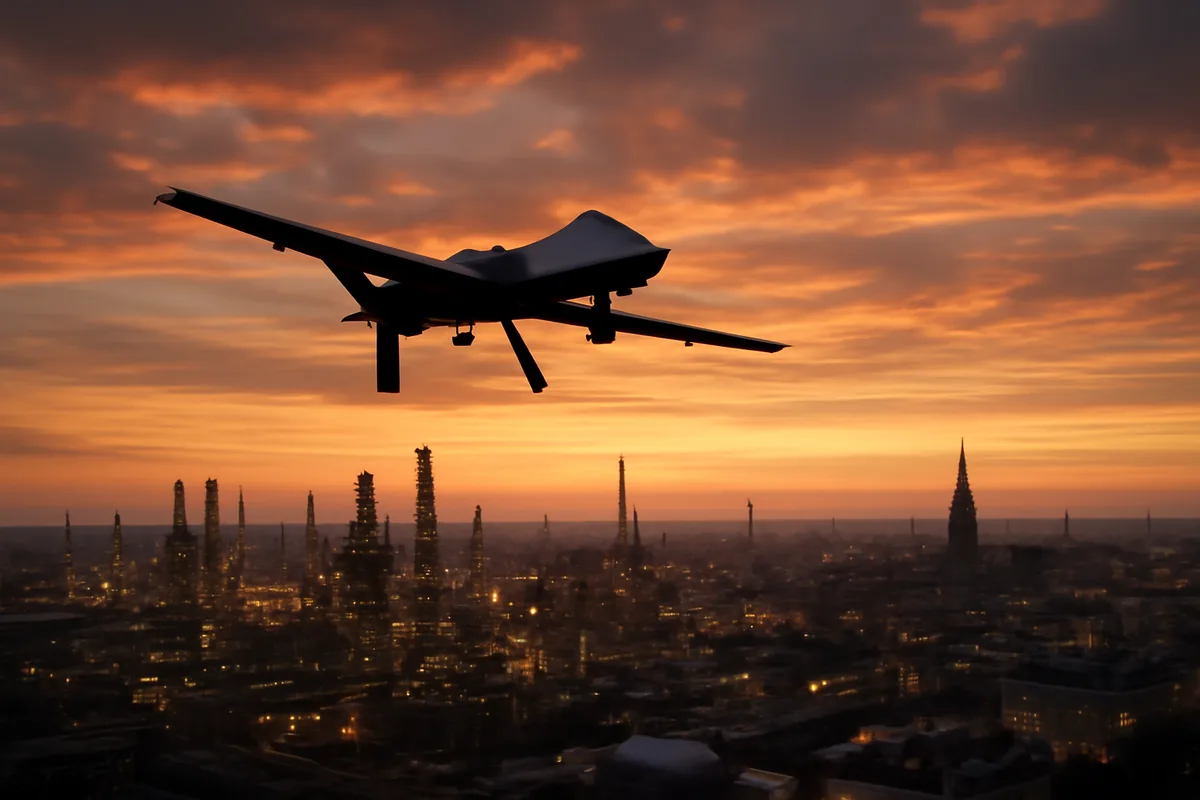
The impact of drone warfare in 2026 is profound, reshaping military strategies and highlighting technological advancements. Recent incidents, such as Ukraine's significant drone assault on Moscow, underscore the evolving role of drones in conflict. This article explores how these developments are influencing geopolitical dynamics and military tactics.
In September 2026, Ukraine launched a substantial drone attack on Moscow, aiming to disrupt Russia's parliamentary elections. Over 1,000 drones targeted Moscow, focusing on key infrastructure like the Gazpromneft-Moscow Oil Refinery. This facility is crucial, as it contributes significantly to Russia's economy and war efforts [1][2].
Despite Russia's claims of intercepting many drones, several reached their targets, causing fatalities and infrastructure damage. The attack resulted in two civilian deaths and injury to twenty people, including children [3]. This highlights the strategic capability of drones to impact adversary resources and morale by striking economically significant targets.
The choice of targets, such as the Gazpromneft-Moscow Oil Refinery, reflects a calculated approach to undermine Russia's war machinery by crippling its economic arteries. This refinery is one of the largest in Russia, with a processing capacity of approximately 11 million tons of oil annually, providing a significant portion of the fuel supply to Moscow [3].
Ukraine's drone strategy involves targeting critical infrastructure to weaken Russia's war capabilities. By aiming at facilities that generate significant economic value, Ukraine seeks to disrupt financial streams supporting Russia's military operations [1].
Selection of High-Value Targets: Ukraine's focus on high-value targets such as energy facilities is strategic. The goal is to handicap the enemy's logistics and economic resources required to sustain prolonged military operations.
Use of Advanced Technology: The deployment of long-range munitions, including Ukrainian-developed missiles like the Flamingo cruise missile and the Pelican ballistic missile, marks a shift towards more sophisticated warfare technology [3]. This approach not only hampers operational logistics but also serves as a psychological tool against opponents.
Psychological Warfare: Beyond physical damage, the psychological impact of these attacks is significant. By successfully targeting Moscow, Ukraine sends a message of capability and resolve, which can erode the morale of both Russian forces and the civilian population.
Innovation and Adaptation: Ukraine has demonstrated innovation by modifying commercially available drones for military purposes, allowing for cost-effective and rapid deployment. This adaptability is crucial in maintaining a tactical edge over a larger adversary.
Drone technology has become central to modern warfare, offering precision, reduced risk to military personnel, and the ability to engage targets remotely. The 2026 drone attacks demonstrate how unmanned systems can significantly alter the dynamics of conflict, allowing nations with smaller military forces to challenge larger adversaries effectively [2].
Cost-Effective: Drones are cheaper than traditional aircraft and require fewer resources to operate. This economic efficiency enables smaller nations or non-state actors to conduct significant military operations without the need for a large conventional force.
Stealth and Precision: Capable of executing precise strikes with minimal detection, drones can infiltrate heavily defended areas without alerting enemy defenses, thus achieving strategic objectives with lower risks of counteraction.
Versatility: Drones are not limited to offensive operations; they are used for surveillance, reconnaissance, and logistical support, providing a comprehensive toolset for modern military operations.
Collateral Damage: The risk of civilian casualties and unintended damage is a significant concern. Despite technological advancements, the precision of drone strikes is not foolproof, leading to ethical dilemmas.
Autonomy and Control: As drones become more autonomous, questions arise regarding the decision-making processes in autonomous systems. Who is accountable for the actions of an unmanned system?
Escalation Risks: The potential for rapid escalation in conflict due to easy deployment of drones is a concern. The low cost and ease of deployment can lead to frequent use, increasing the risk of unintended escalation.
The integration of artificial intelligence (AI) and machine learning into drone operations is further transforming warfare. AI can enhance target acquisition and decision-making processes, allowing drones to operate in complex environments with minimal human intervention. However, this raises concerns about the ethical implications of autonomous kill decisions.
The use of drones in warfare raises significant geopolitical and ethical considerations. As state and non-state actors gain access to advanced drone technologies, the potential for escalated conflicts increases. Moreover, the integration of AI and machine learning into drone operations poses questions about decision-making autonomy and accountability [1][3].
Proliferation of Drone Technology: The accessibility of drone technology means that even non-state actors can procure and deploy drones, potentially destabilizing regions.
Shift in Military Doctrine: Nations are compelled to revise military doctrines to incorporate drone warfare, emphasizing speed, precision, and reduced human casualties.
Countries must navigate these challenges by developing international regulations and ethical frameworks to manage the deployment of drone technology in warfare. This includes establishing clear guidelines on the use of autonomous systems and ensuring accountability for actions taken by unmanned vehicles.
Steps Towards Regulation:
International Treaties: Establishing treaties that govern the use of drones in warfare, similar to those for nuclear weapons, to prevent misuse.
Transparency and Accountability: Implementing transparency measures where nations disclose drone operations to prevent misinformation and misunderstandings.
Ethical Oversight: Creating ethical oversight bodies to evaluate and guide the use of drones, particularly autonomous models, to ensure compliance with international law and ethical standards.
The impact of drone warfare in 2026 is unmistakable, as seen in Ukraine's strategic use against Moscow. As technology continues to evolve, its role in military conflicts will only grow, prompting nations to reassess their defense strategies and ethical responsibilities. The need for international cooperation and regulation is paramount to mitigate risks and maximize the potential benefits of drone technology in maintaining global peace and security."}
Drone warfare in 2026 significantly influences military strategies, as seen in Ukraine's attack on Moscow. Drones enable precision targeting of critical infrastructure, affecting economic and military capabilities.
Ukraine launched over 1,000 drones targeting Moscow to disrupt Russian elections and damage key infrastructure like the Gazpromneft-Moscow Oil Refinery, highlighting strategic drone usage.
Drones offer cost-effectiveness, stealth, and precision, enabling versatile roles in surveillance, combat, and logistical support, while minimizing military personnel risk.
Drones raise ethical issues like collateral damage risk, autonomous decision-making, and escalation potential, necessitating international regulations and ethical frameworks.
Advancements in drone technology, including AI integration and long-range munitions, enhance precision and impact, reshaping the dynamics and strategies of modern conflicts.
More from Technology & AI.
AI is reshaping data center strategies, with Anthropic and OpenAI pursuing smaller, faster deals to meet growing AI demands in 2026.
Find the best password managers for small businesses in 2026 to improve security and streamline operations with essential features.
Learn to navigate World of Warcraft Forever using gamepad controls and enhance your gameplay experience in this reimagined MMO world.